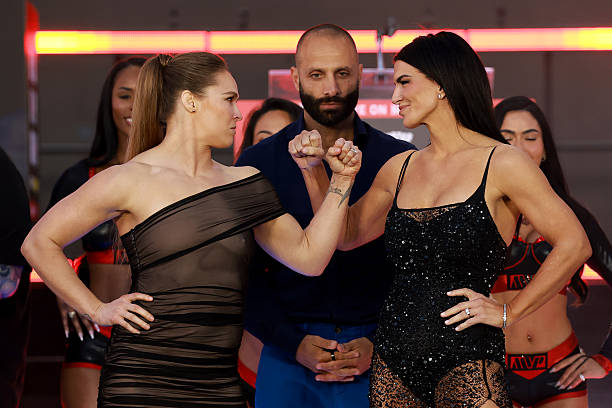


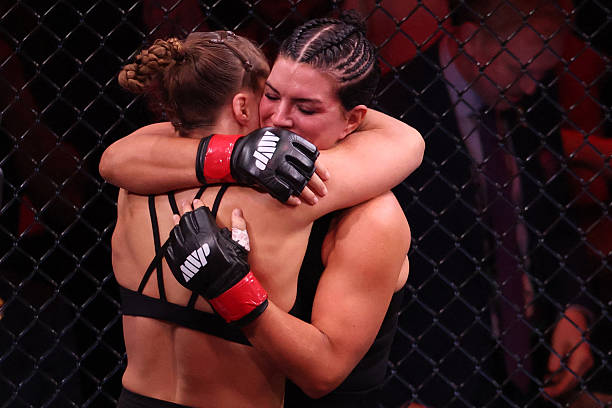
This weekend noticed the return of two infamous girls blended martial artists to competitors, Ronda Rousey and Gina Carano, with Rousey incomes a spherical one 17-second armbar end in the course of the Most Useful Promotions debut MMA occasion.
Earlier than their rise, girls’s blended martial arts existed totally on the margins of the game, scattered throughout regional promotions, typically ignored and incessantly questioned as a official a part of MMA’s future. As we speak, that panorama seems fully totally different. Ladies headline main UFC playing cards, produce world champions throughout a number of divisions and compete in a sport that not treats their presence as an exception.
Ronda Rousey, Gina Carano and the rise of ladies’s MMA
Whereas each Rousey and Carano have been trailblazers for the game, their legacies are outlined by what they achieved contained in the cage. And they’re outlined by what got here after: how girls’s MMA grew past its early limitations and what it has turn out to be within the years since. However that shift makes extra sense once you have a look at the place girls’s MMA started.
Earlier than girls’s MMA entered the UFC mainstream, it existed in smaller, fragmented promotions reminiscent of Strikeforce, which was later bought by the UFC in 2011, and EliteXC, which went bankrupt in 2008 earlier than its roster and belongings had been absorbed by Strikeforce.
One of many first girls to attain mainstream visibility was Carano. Her Strikeforce bout towards Cris Cyborg for the featherweight title in 2009 marked the primary time a significant MMA promotion featured a girls’s combat as a fundamental occasion. Whereas Carano got here up brief in that combat, it didn’t go unnoticed. Rousey took notice of Carano’s success in Strikeforce and noticed a path to construct on that momentum.
Rousey, already well-versed in combat sports, gained a gold medal for america in judo on the 2008 Olympic Video games. Previous to the UFC’s acquisition of ladies’s MMA, she additionally grew to become a dominant bantamweight champion in Strikeforce.
The UFC initially dismissed the thought of introducing a girls’s division, citing a scarcity of depth in expertise and restricted curiosity within the sport. Nevertheless, after signing Rousey in 2013, the UFC named her the primary girls’s bantamweight champion, formally establishing the division.
Then, in February 2013, UFC 157 marked Ronda Rousey’s first UFC appearance, the place she defended her bantamweight championship towards Liz Carmouche. Rousey got here out on high, incomes a submission victory through her signature armbar. With that win, girls’s MMA firmly entered the mainstream dialog.
Rousey shortly grew to become a family identify, and the UFC marketed her as the subsequent main star of the game all through the mid-2010s. She went on a five-fight profitable streak from 2013 to 2015 earlier than dropping her bantamweight title to Holly Holm in November 2015. Her closing UFC look got here in December 2016, when she was defeated by Amanda Nunes in a first-round TKO.
Regardless of back-to-back losses on the finish of her profession and her eventual exit from the game, Rousey’s legacy remained intact. Her rise between 2013 and 2015 helped speed up the expansion of ladies’s MMA, because the UFC expanded its girls’s roster and constructed out new divisions.
The UFC launched the 115-pound strawweight division in 2014, adopted by the 125-pound flyweight division in 2017 and the 145-pound featherweight division later that very same 12 months. Across the similar time, extra girls fighters had been featured on The Final Fighter, additional increasing visibility for the game.
As Rousey’s period got here to a detailed, a brand new customary started to take form on the high of ladies’s MMA. Nunes emerged because the defining determine of the post-Rousey panorama, reshaping expectations of what elite girls’s combating may seem like.
In just some years, girls’s participation in MMA quickly expanded, and the depth of expertise shortly surpassed what existed throughout Rousey’s rise. That doesn’t diminish Rousey’s influence, however as a substitute highlights how shortly girls’s MMA developed after she helped carry it into the mainstream. Nunes’ TKO victory over Rousey served as one of many clearest indicators of that evolution.
Over the subsequent a number of years following Rousey’s closing UFC look, Nunes grew to become the defining face of ladies’s MMA and a logo of the game’s rising legitimacy. However together with her dominance got here a brand new technology of elite opponents and champions, together with Valentina Shevchenko, Zhang Weili, Joanna Jędrzejczyk, and Rose Namajunas.
That evolution was not solely felt on the skilled stage. Since 2013, girls have turn out to be one of many fastest-growing demographics in MMA, based on MMA INC. Ladies are additionally not handled as an unusual presence in MMA gyms, as feminine participation in beginner MMA has continued to develop worldwide.
In line with the Worldwide Blended Martial Arts Federation, the ratio of feminine athletes elevated from one in seven opponents to at least one in 5 between 2023 and 2025. Ladies’s MMA is not combating for legitimacy. From regional gyms to UFC fundamental occasions, the game has grown into a totally established a part of fashionable blended martial arts.
Fighters like Carano and Rousey helped open the door, however the generations that adopted proved it was by no means going to shut once more.