

Basketball agility drills prepare gamers to speed up, cease, and alter route shortly whereas staying balanced and below management.
They enhance footwork, physique management, and the flexibility to react to what an opponent does.
Velocity is transferring quick in a single route. Quickness is step one. Agility is altering route below management whereas doing both… and it is the one which decides most possessions.
Coaches use them earlier than and throughout the season, normally in brief blocks after the warm-up, and gamers can use most of them on their very own.
Beneath are the 12 basketball agility drills I like to recommend, plus the teaching factors that apply to all of them and the best way to match them into apply with out losing time.
12 Basketball Agility Drills
The drills are grouped by what they want and what they prepare. Cone drills and pace drills want a court docket and a coach. Ladder drills and the no-equipment drills are ones gamers can do on their very own. Each drill makes use of the identical format so you’ll be able to scan for the one you need.
On-Courtroom Agility Drills With Cones
These 4 drills use the strains of the court docket and some cones. They’re the drills most coaches imply once they say “agility drills,” and three of them might be timed and used as exams.
Cones are the one gear you may want.
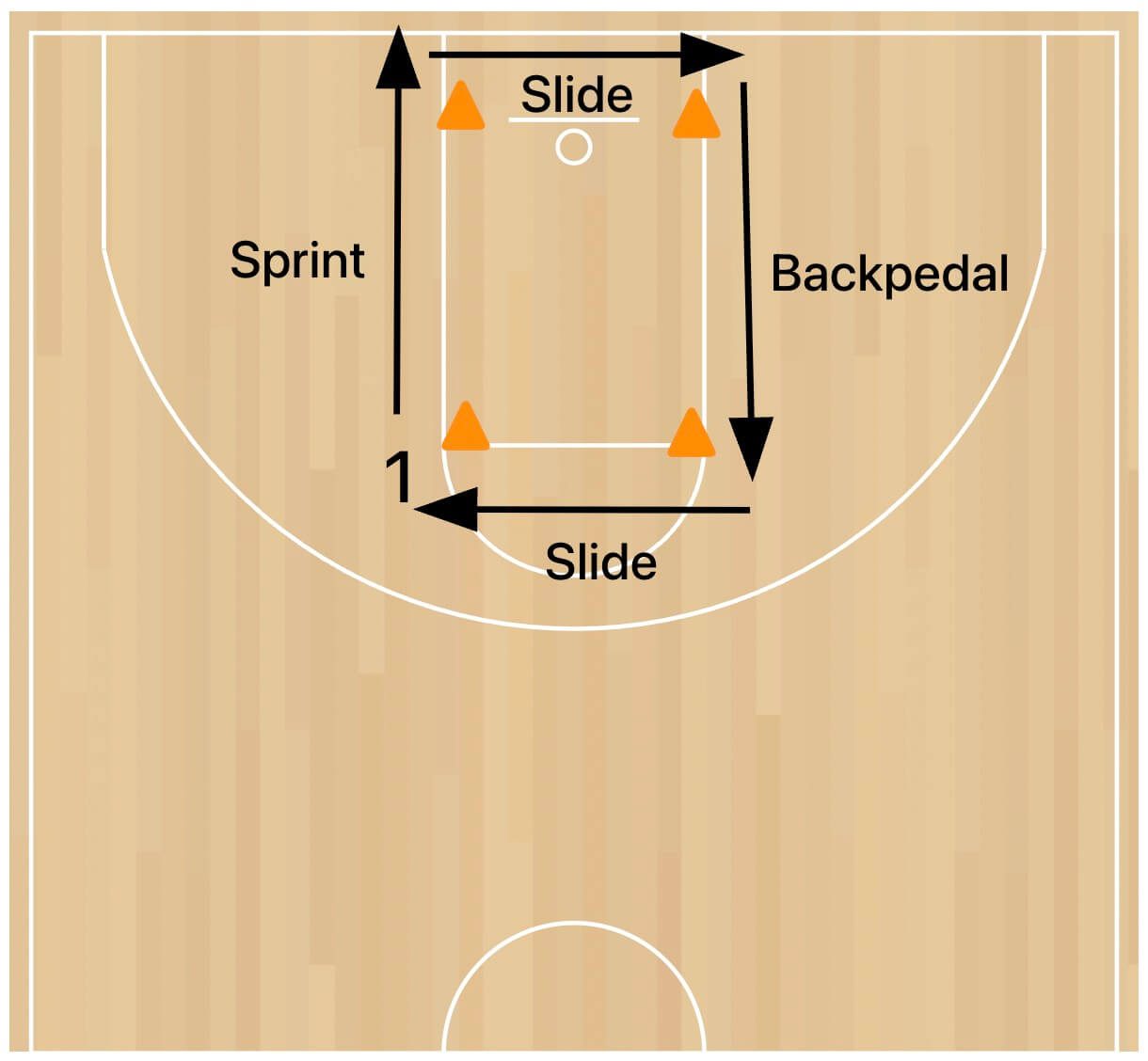
1. Lane Agility Drill
How the Drill Works:
Gamers dash, slide, and backpedal across the 4 corners of the important thing as quick as they’ll, then repeat the sample in the wrong way.
Goal:
That is the agility take a look at used on the NBA Draft Mix. It covers the three actions defenders use most (dash, defensive slide, backpedal) and forces a fast transition between every one.
Set-Up:
Place a cone on every nook of the important thing: each elbows and each spots the place the lane line meets the baseline.
One participant at a time. A coach with a stopwatch.
Directions:
- The participant begins on the left elbow, dealing with the baseline.
- On “go,” dash to the baseline cone.
- Defensive slide throughout the baseline to the other cone.
- Backpedal to the best elbow.
- Defensive slide throughout the free-throw line again to the beginning cone.
- With out stopping, reverse the entire sample: slide proper, backpedal to the baseline, slide left, dash to the beginning.
Teaching Factors:
- Gamers should keep dealing with the identical route all the drill. No turning to run.
- Plant the skin foot on each change of route and push off it.
- Time each rep and submit the occasions. Gamers will compete with one another with out being instructed to.
2. Professional Agility Drill (5-10-5)
How the Drill Works:
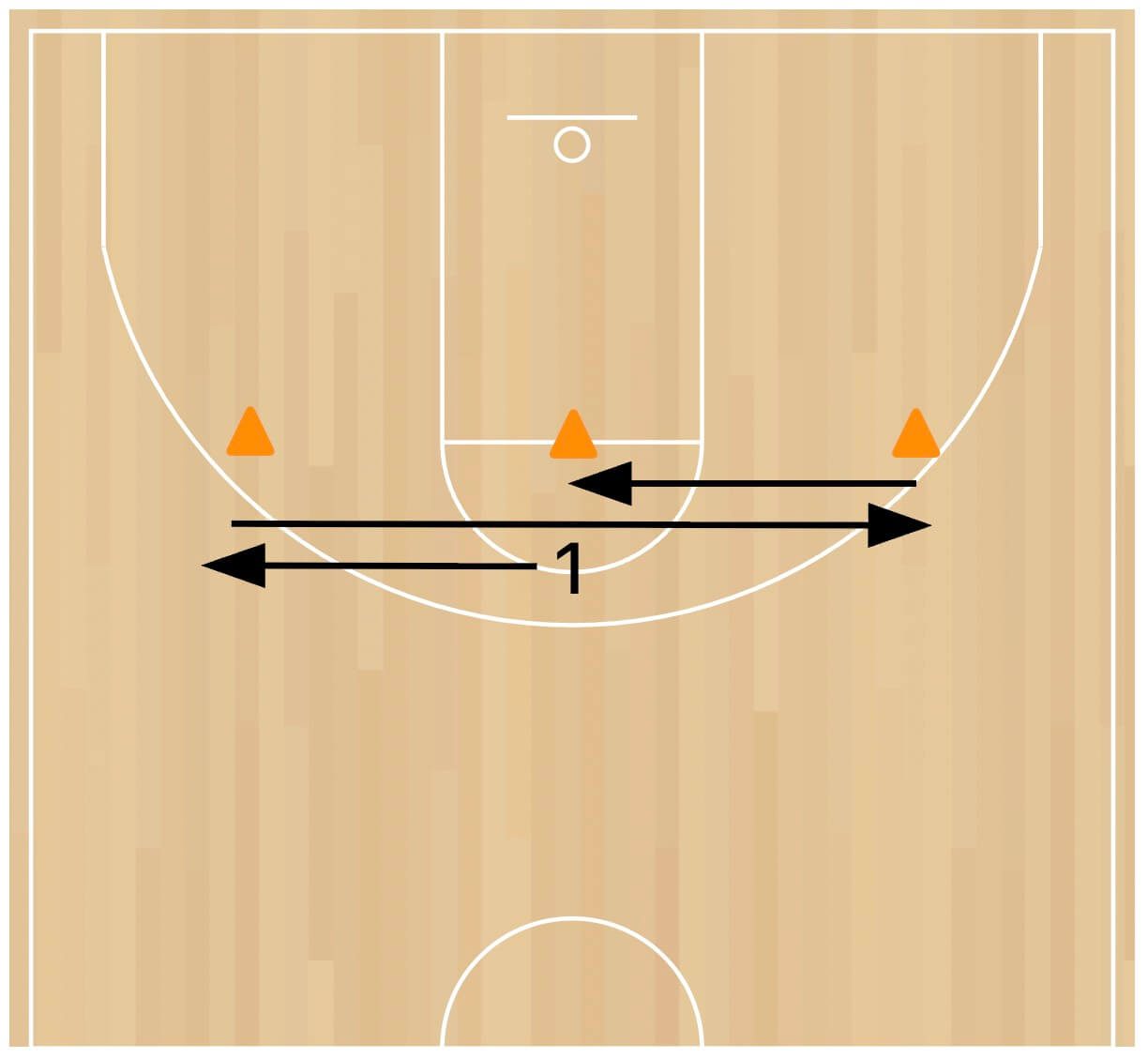
Gamers dash 5 yards to 1 aspect, 10 yards again the opposite manner, then 5 yards via the center to complete.
Goal:
The professional agility drill works on stopping and restarting over a brief distance. Twenty yards whole, however with two full adjustments of route in the course of it.
Set-Up:
Three cones in a straight line, 5 yards aside (the free-throw line to the baseline is shut sufficient).
The participant straddles the center cone in an athletic stance.
Directions:
- On “go,” the participant turns and sprints to both exterior cone and touches the ground subsequent to it with their hand.
- Change route and dash 10 yards to the far cone. Contact the ground.
- Change route once more and dash again via the center cone to complete.
Teaching Factors:
- Dash THROUGH the ultimate cone. Gamers who decelerate earlier than it are including half a second.
- Keep low on the turns. A participant who stands up straight to vary route has to sit down again down earlier than they’ll push off.
- Run it in each instructions. Most gamers are noticeably slower turning a technique.
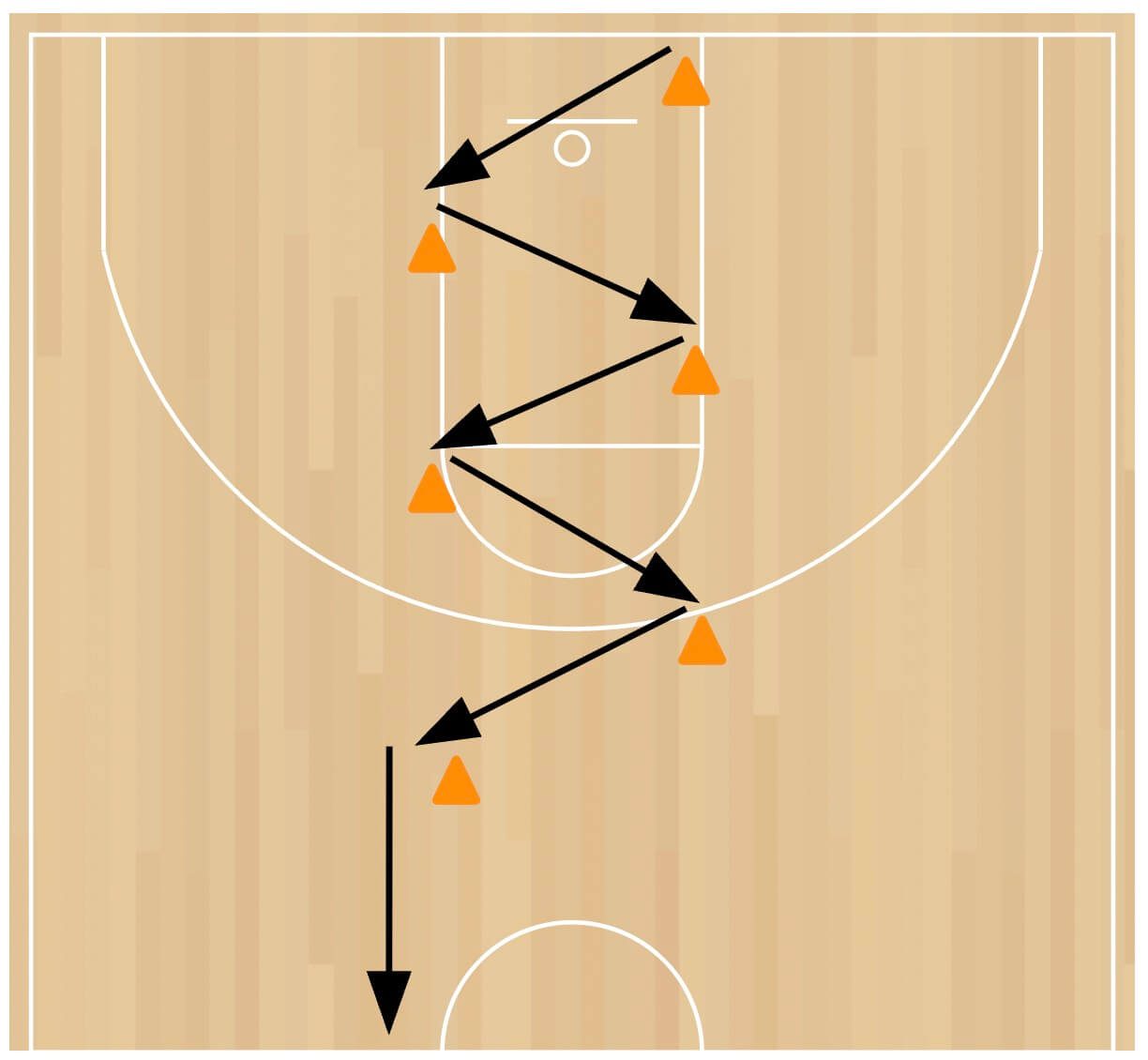
3. Zig-Zag Dash
How the Drill Works:
Gamers dash via a zig-zag course of cones the size of the ground, altering route at every one.
Goal:
This drill forces a pointy change of route each few steps at full pace. It trains gamers to decelerate, plant, and re-accelerate with out slowing to a jog, which is what reducing and attacking in transition ask for.
Set-Up:
Six to eight cones in a zig-zag sample from baseline to baseline, utilizing the lane strains and the sideline as guides.
Gamers line up on the baseline.
Directions:
- The primary participant sprints to the primary cone.
- On the cone, plant the skin foot and reduce arduous towards the subsequent cone.
- Proceed the sample to the far baseline.
- The following participant goes when the participant in entrance reaches the second cone.
Variations:
Add a Ball – Gamers dribble the course. Now it is a change-of-direction dribbling drill too.
Race It – Arrange two an identical programs and run it as a relay.
Teaching Factors:
- The reduce at every cone is the entire drill. Gamers who not far away as a substitute of planting are skipping the arduous half.
- Keep low into the cone and explode out of it. Standing as much as change route is what makes gamers sluggish.
4. Determine 8 Drill
How the Drill Works:
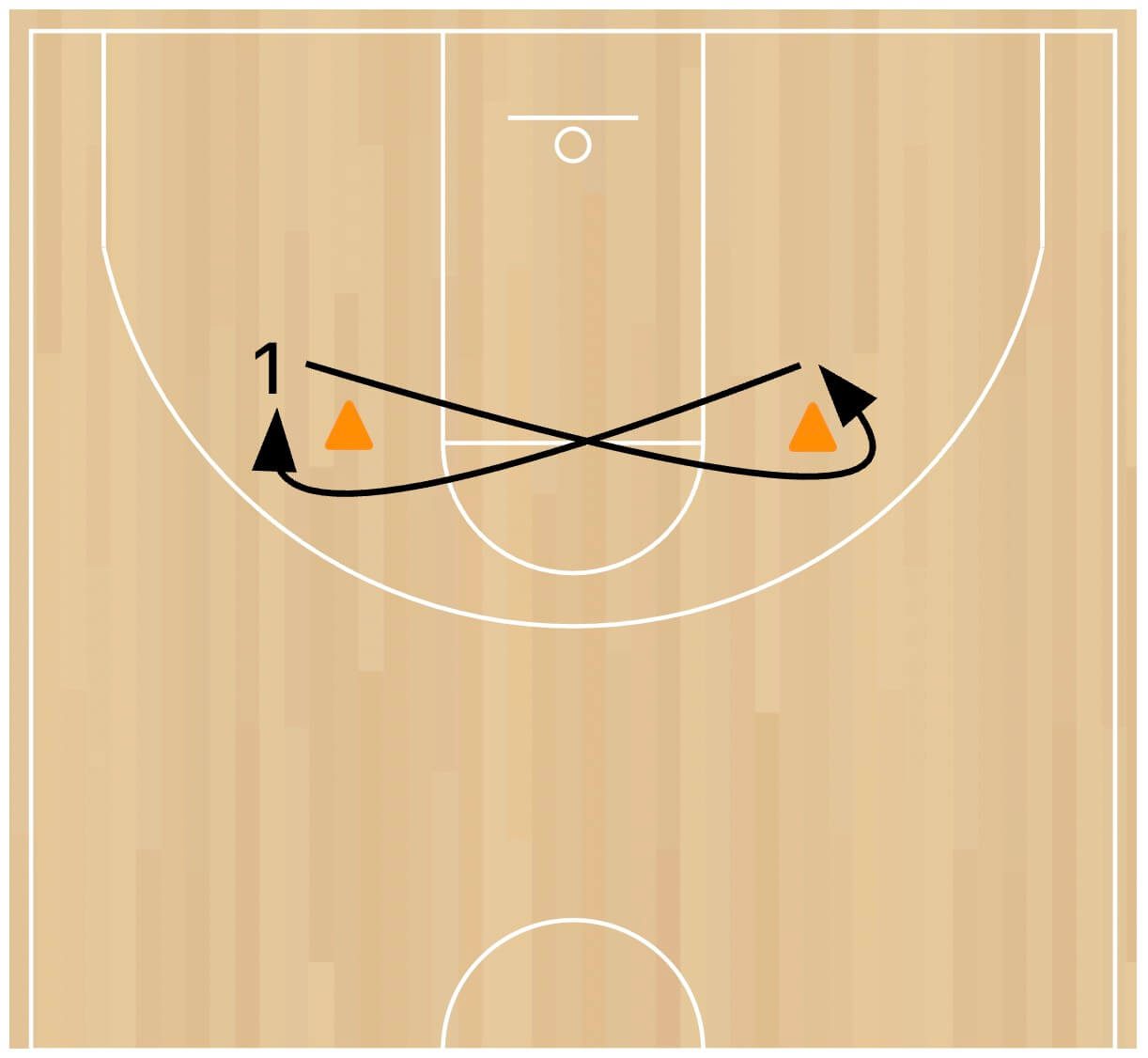
Gamers dash in a determine 8 sample round two cones whereas being timed.
Goal:
The determine 8 works on acceleration, deceleration, and turning. The timing aspect makes gamers push the pace of the flip as a substitute of jogging round it.
Set-Up:
Two cones 10-15 toes aside, wherever on the court docket.
Directions:
- The participant begins barely behind and to the skin of both cone.
- On the whistle, dash in a determine 8 sample across the exterior of each cones.
- Repeat the sample 8 occasions as quick as potential.
- Relaxation (or let one other participant go), then repeat and attempt to beat the primary time.
Teaching Factors:
- Get low on the flip. A decrease centre of gravity makes it simpler to decelerate, flip, and explode out.
- This may be accomplished with a basketball. With a ball it turns into extra of a dribbling drill than an agility drill, which is ok, simply know which one you are working.
Velocity and Quickness Drills
The cone drills above are pre-planned. Gamers know the place the subsequent flip is.
A sport is not like that…
These three drills add both a sprint-to-stop aspect or a response aspect, so gamers are altering route as a result of one thing occurred, not as a result of a cone instructed them to.
5. Dash to Backpedal
How the Drill Works:
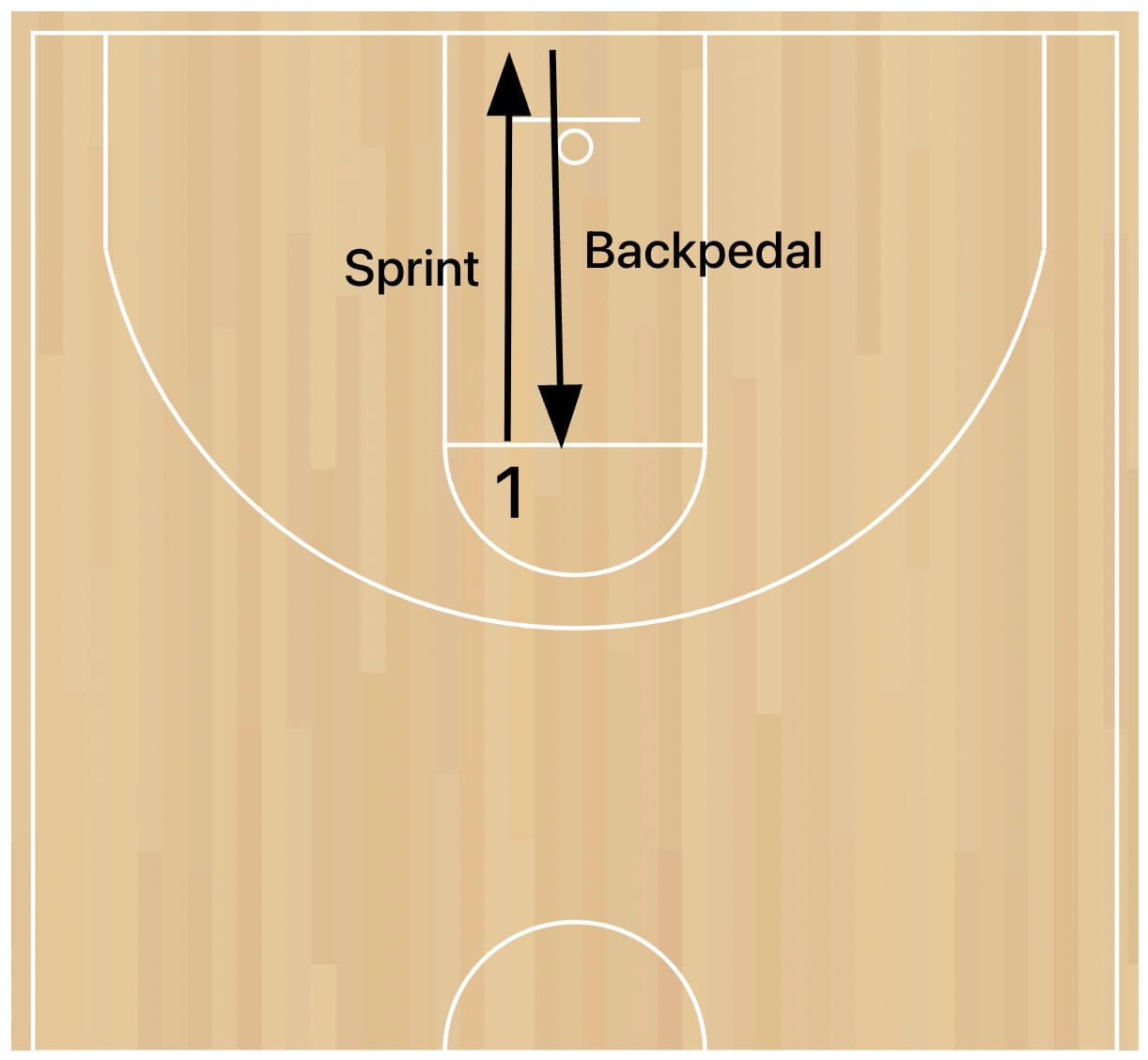
Gamers dash ahead, cease, and instantly backpedal to the place they began.
Goal:
That is the transition from offense to protection. A participant who can dash, plant, and get transferring backwards with out three shuffle steps in between will get again on protection a full second sooner.
Set-Up:
Two strains 15 toes aside. The baseline and the free-throw line work.
Directions:
- Begin on the baseline in an athletic stance.
- Dash to the free-throw line.
- Plant, drop the hips, and backpedal to the baseline.
- That is one rep. Do 6-8 reps with a brief relaxation between.
Variations:
Dash to Soar Cease – Change the plant with a jump stop, maintain it for a rely, then backpedal. Nice for youthful gamers who wrestle to cease below management.
Teaching Factors:
- The cease is the talent, not the dash. Watch the deceleration.
- On the backpedal, lean barely ahead. Gamers who lean again fall over.
6. Cone Response Drill
How the Drill Works:
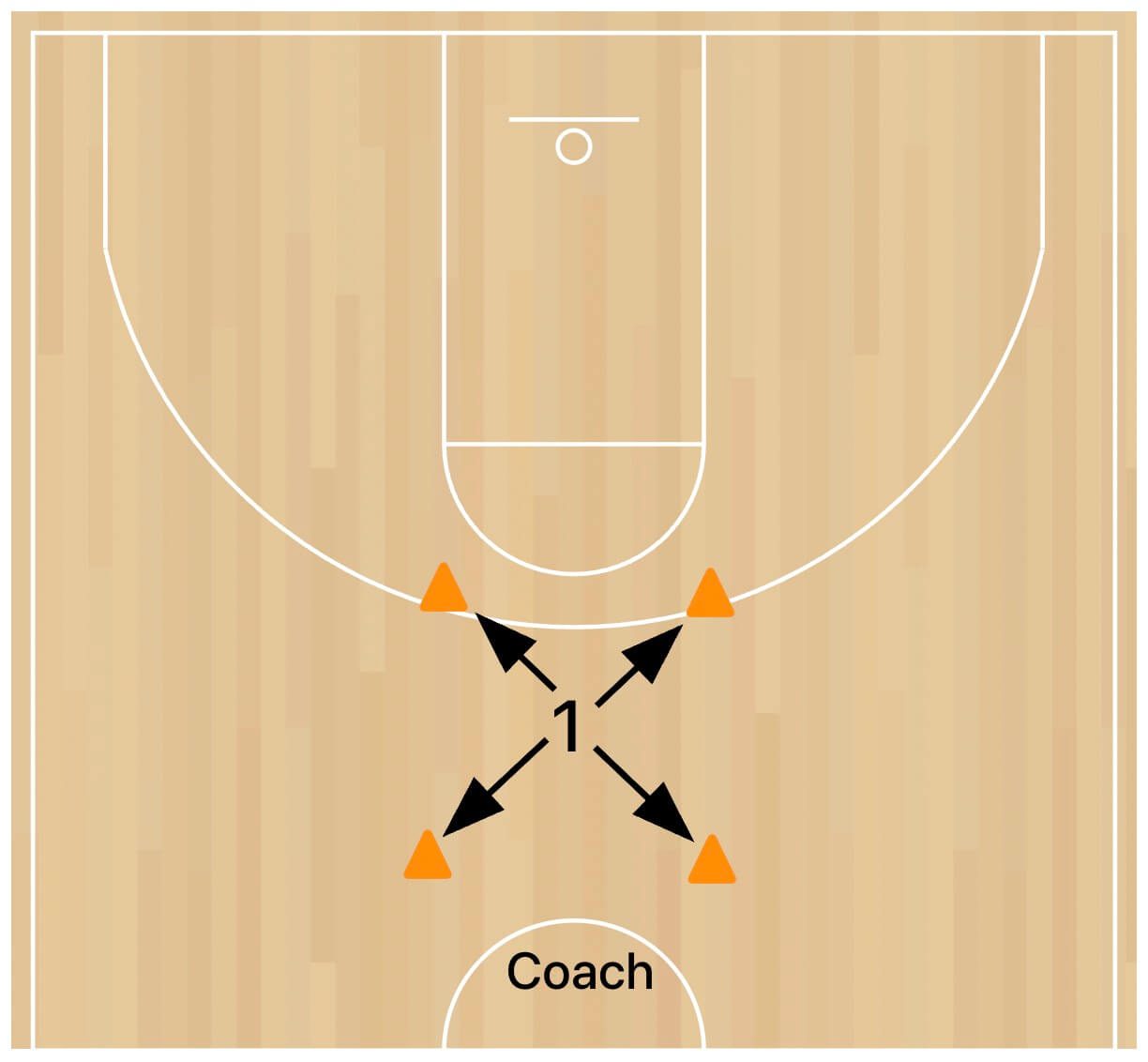
A participant stands in the course of 4 cones and sprints to whichever one the coach factors at.
Goal:
Response. The participant has no concept which route is subsequent, in order that they have to remain low and prepared in each route directly… precisely like guarding the ball.
Set-Up:
4 cones in a sq. about 10 toes aside. The participant begins within the center in a defensive stance.
The coach or a accomplice stands in entrance of them.
Directions:
- The coach factors to a cone.
- The participant sprints to it, touches it, and sprints again to the center.
- As quickly as they’re again, the coach factors once more.
- Go for 20-30 seconds, then rotate gamers.
Variations:
Slide As a substitute of Dash – Defensive slide to the aspect cones, dash to the entrance cone, backpedal to the again cone.
Name It Out – Quantity the cones and name numbers as a substitute of pointing. More durable, as a result of gamers cannot depend on watching your hand.
Teaching Factors:
- Gamers should reset to a stance within the center each time. In the event that they arise straight between reps, the drill is not doing something.
- Range the timing. Do not allow them to settle right into a rhythm.
7. Accomplice Mirror Drill
How the Drill Works:
Two gamers face one another. One leads, sliding left and proper at random. The opposite mirrors them.
Goal:
The defender is reacting to an actual particular person, not a cone. John Calipari has a line about this: “That cone has no arms.” Cones do not pretend, hesitate, or change their thoughts. Companions do.
Set-Up:
Two gamers dealing with one another about 6 toes aside, each in a defensive stance. Two strains on the ground 10-12 toes aside mark the boundaries.
Directions:
- The chief slides left and proper at random, altering route every time they need, staying between the strains.
- The mirror participant stays immediately in entrance of them.
- Go for 15-20 seconds, then swap roles.
Variations:
Add a Ball – The chief dribbles. Now the defender is studying a dribbler.
Dwell 1-on-1 – After a couple of seconds of mirroring, the coach says “reside” and the chief assaults the basket. Now it is a sport.
Teaching Factors:
- The mirror participant’s eyes needs to be on the chief’s hips, not their toes or the ball. Hips cannot pretend.
- That is the drill that transfers most on to guarding the ball. Run it greater than the others.
Agility Ladder Drills
Velocity ladder drills are probably the most extensively used agility drills in basketball, and those most probably to get overused.
They’re good for one factor… fast, gentle, correct toes.
They do not train a participant to vary route in opposition to an opponent, and so they will not make anybody sooner up the ground. Use them as a warm-up or in a participant’s personal exercise, not as a giant block of staff apply time.
8. Ladder Drills
How the Drill Works:
The ladder lies flat on the ground. Gamers transfer from one finish to the opposite utilizing a set footwork sample.
Goal:
Foot pace, coordination, and rhythm. The patterns pressure gamers to consider the place every foot lands, which is the purpose.
Set-Up:
A pace ladder, or tape on the ground in a ladder form. Gamers can do these alone.
One warning: ladders slide on a hardwood flooring. Tape the ends down or run them on a rubber floor.
Directions:
Begin at one finish and work via a sample to the opposite finish. Begin sluggish sufficient to get the sample proper, then add pace.
The patterns I exploit most:
1. One Foot In Every Field – Run via with one foot touchdown in each field. The fundamental sample.
2. Two Toes In Every Field – Each toes land in each field earlier than transferring to the subsequent. Twice the foot contacts.
3. Lateral Two Toes In – Transfer sideways down the ladder, each toes entering into every field. Closest to a defensive slide.
4. In-In-Out-Out – Each toes within the field, then each toes out to the perimeters, then into the subsequent field.
5. Icky Shuffle – Left foot in, proper foot in, left foot out to the aspect. Then proper foot in, left foot in, proper foot out. Repeat down the ladder.
6. Single-Leg Hops – Hop via on one leg, then come again on the opposite.
Teaching Factors:
- Keep on the balls of the toes all the time.
- Pump the arms. Gamers who go away their arms hanging at their sides transfer their toes slower.
- Rotate the patterns. The identical two patterns day-after-day will get monotonous quick.
Agility Drills With out Gear
Gamers will ask what they’ll do at house.
These 4 want a line on the ground, a rope, or a tennis ball. All of them work in a driveway.
9. Line Drills
How the Drill Works:
Gamers leap over a line on the ground, backwards and forwards, as many occasions as potential in a set time.
Goal:
Gentle toes and fast footwork. The road provides gamers one thing to be correct about.
Set-Up:
A line on the ground, or a bit of tape. A number of sq. toes of house.
Directions:
Begin on one aspect of the road. Soar to the opposite aspect, leap again, and preserve going for the set time. 20-30 seconds is a lot.
The variations:
1. Two Toes, Entrance to Again – Soar ahead over the road and again.
2. Two Toes, Aspect to Aspect – Identical factor, laterally.
3. One Foot, Entrance to Again – On one leg. Change legs every set.
4. One Foot, Aspect to Aspect – The toughest one for many gamers.
5. Scissors – Land with one foot on both sides of the road, then change them within the air.
Teaching Factors:
- Keep on the balls of the toes. If the heels contact, the jumps get sluggish and heavy.
- Fast, not excessive. The purpose is the variety of contacts, not the peak of the leap.
10. Soar Rope
How the Drill Works:
Normal leap rope, with variations that work footwork and coordination.
Goal:
Leaping rope improves hand-foot coordination, stability, and rhythm, and it teaches gamers to be gentle on their toes with out anybody telling them to.
Set-Up:
A leap rope and a few house.
Directions:
Choose a variation, then both rely what number of jumps you get in a set time or time how lengthy a set quantity takes. All the time have a goal to beat.
1. Two-Foot Jumps – The fundamental one.
2. Alternating Toes – Like working on the spot.
3. Single Leg – 10-20 on every leg.
4. Aspect to Aspect – Two-foot jumps transferring a couple of inches left and proper.
5. Double Unders – Two rope passes per leap. Solely as soon as the fundamentals are automated.
Teaching Factors:
- Fast jumps, not excessive ones. Most gamers instinctively leap too excessive. An inch off the ground is sufficient.
- Maintain the palms barely above the waist, elbows bent, palms a few foot from the perimeters.
11. Foot-Ups With Tennis Ball
How the Drill Works:
Gamers do fast step-ups on high of a basketball whereas catching and returning a tennis ball tossed by a accomplice.
Goal:
Agility in a sport normally means doing one thing with the toes and the palms on the identical time, like a guard beating a defender off the dribble whereas protecting the ball away from the assistance.
This drill trains each directly.
Set-Up:
- A basketball on the ground on the participant’s toes
- A tennis ball
- A accomplice or coach standing 8-10 toes away, holding the tennis ball
Directions:
- The participant faucets the highest of the basketball with alternating toes, protecting the ball in place.
- Whereas they’re stepping, the accomplice underhand tosses the tennis ball.
- The participant catches it with one hand and tosses it again with out stopping their toes.
- Units of 30 seconds to a minute.
Variations:
On the Transfer – The coach calls “ahead” or “again” and the participant rolls the basketball that route with their toes whereas persevering with the step-ups. Small, fast steps that transfer the ball an inch or two at a time, not huge steps.
Teaching Factors:
- Balls of the toes the entire time. Heels by no means contact.
- If a participant cannot preserve the basketball nonetheless, drop the tennis ball and allow them to get the step-ups proper first.
12. Closeout Sequence
How the Drill Works:
Gamers dash from the baseline to a spot, break down right into a closeout, then react to a coach’s name.
Goal:
The closeout is the most typical agility motion on protection: full dash, then a managed cease, then a response. This drill practices all three without having an offensive participant.
Set-Up:
Gamers on the baseline. A coach on the free-throw line. No gear wanted, however a cone on the spot helps youthful gamers.
Directions:
- On “go,” the primary participant sprints towards the coach.
- Two-thirds of the best way there, break down into quick, uneven steps, one hand up, weight again.
- The coach calls “left,” “proper,” or “shot.”
- On “left” or “proper,” the participant drop steps and slides two slides that route. On “shot,” they leap to contest with the hand up.
- Backpedal to the baseline and the subsequent participant goes.
Teaching Factors:
- The breakdown steps begin sooner than gamers assume. Most dash too far and may’t cease.
- Excessive hand, low hips. Gamers who stand as much as contest are straightforward to drive previous.
Teaching Factors for Each Agility Drill
The drills change. These do not.
1. Keep Low – Each change of route begins with the hips down. A participant who stands up straight has to sit down again down earlier than they’ll push off, and that is the half second the offense wants.
2. Plant the Outdoors Foot – To go left, plant the best foot and push off it. Planting the within foot means a stumble step earlier than the precise transfer.
3. By no means Cross the Toes on a Slide – Toes crossed means toes tangled. Step, slide, step, slide.
4. Hips Lead, Toes Comply with – Gamers who attempt to change route with their toes alone are sluggish. Flip the hips first and the toes include them.
5. Prepare the Cease, Not Simply the Begin – Deceleration is half of agility and the half no one practices. A participant who can cease below management at full pace can change route at full pace.
6. High quality Earlier than Velocity – Get the sample proper sluggish, then add pace. Sloppy quick is simply sloppy.
7. Time It and Retest – The lane agility, professional agility, and determine 8 drills are all exams. File occasions firstly of the season and once more each month. Gamers push more durable when there is a quantity.
8. Bear in mind That Cones Do not React – A cone course trains change of route. It doesn’t prepare response, as a result of the participant already is aware of the place the subsequent flip is. That is why the response drills and the mirror drill matter greater than the cone drills… although they appear much less spectacular.
Why Agility Issues in Basketball
Basketball just isn’t performed in a straight line.
Each possession asks gamers to cease, begin, and alter route… normally whereas reacting to another person.
This is the place agility reveals up in a sport:
1. Closing Out – Sprinting at a shooter, then breaking down into quick steps so that you’re balanced sufficient to contest with out flying previous.
2. Slicing Off a Drive – Sliding to beat the dribbler to a spot, then altering route the second they crossover.
3. Slicing to Get Open – A V-cut or a tough change of tempo off a display screen solely works if the participant can plant and go the opposite manner with out slowing down.
4. Altering Speeds on a Drive – Slowing all the way down to get the defender off stability, then accelerating previous them. The deceleration is the arduous half.
5. Unfastened Balls and Rebounds – The participant who reacts first and strikes first will get the ball.
That is the purpose of those drills. Gamers cannot do a lot about their genetics, however they’ll enhance how they cease, plant, and go… and that is what will get educated right here.
Find out how to Use Agility Drills at Apply
A number of guidelines for becoming these into apply with out losing time on them:
1. Maintain the Block Brief – 10-Quarter-hour, straight after the warm-up and earlier than talent work. Agility work wants recent legs. Doing it on the finish of apply when gamers are drained trains dangerous motion.
2. Two or Three Drills, Not Twelve – Choose two or three per session and rotate them throughout the week. Cone drills sooner or later, response drills the subsequent.
3. Extra Off-Season, Much less In-Season – Within the low season, two or three classes every week. In-season, as soon as every week is a lot to take care of it. Apply time in-season is just too useful.
4. Ladders and Traces Belong in Particular person Exercises – Ladder drills, line drills, and leap rope are issues gamers can do alone. Put them in your gamers’ individual workouts and spend staff time on the drills that want a coach or a accomplice.
5. Agility Drills Are Not a Repair for Defensive Issues – This one issues. In case your gamers are getting blown by on protection, lateral quickness isn’t the actual difficulty. What most gamers wrestle with is studying their opponent and anticipating what comes subsequent, and that solely develops by competing in opposition to reside gamers. Run the agility block, then spend the majority of apply on 1-on-1, 2-on-2, and 3-on-3 video games. That is the place defenders are made.
6. Use the Assessments – Run the lane agility drill and the professional agility drill at tryouts and once more mid-season. It is an goal quantity for a talent that is in any other case arduous to measure.
FAQ
What are 5 good workouts for agility?
Lane agility drill, professional agility drill (5-10-5), zig-zag sprints, cone response drill, and ladder drills. Between them they cowl sprinting, sliding, backpedaling, and reacting, which is every little thing basketball asks for.
What’s the 5-10-5 agility drill?
The 5-10-5, additionally referred to as the professional agility drill or the shuttle run, makes use of three cones 5 yards aside. The participant begins on the center cone, sprints 5 yards to 1 aspect, 10 yards to the far cone, then 5 yards again via the center. It is timed, and it is used as an agility take a look at in basketball, soccer, and most different sports activities.
Are you able to do basketball agility drills at house?
Sure. Line drills, leap rope, foot-ups with a tennis ball, and ladder drills (with tape on the ground if you do not have a ladder) all work in a driveway or storage. The professional agility drill solely wants 10 yards of house and three markers.
What agility drills are finest for teenagers and inexperienced persons?
Line drills, leap rope, and the determine 8 drill. They’re easy, they’re secure, and youngsters can see themselves enhancing shortly. For younger gamers, preserve every little thing quick and enjoyable. Ten minutes is a lot. Turning it right into a race is normally all of the motivation they want, and our basketball drills for kids web page has extra.
How usually ought to basketball gamers do agility drills?
Two or three quick classes every week within the low season, as soon as every week in-season. Fifteen minutes with good type beats an hour of sloppy reps.
Conclusion
Basketball agility drills give gamers the bodily instruments to cease, begin, and alter route below management.
Begin with the on-court cone drills so you’ll be able to take a look at and time your gamers, add the response drills in order that they’re studying to maneuver due to one thing they see, and go away the ladders and leap ropes for particular person exercises.
Then get them taking part in. Agility drills construct the toes… competing in opposition to actual gamers teaches them when to make use of them.
