

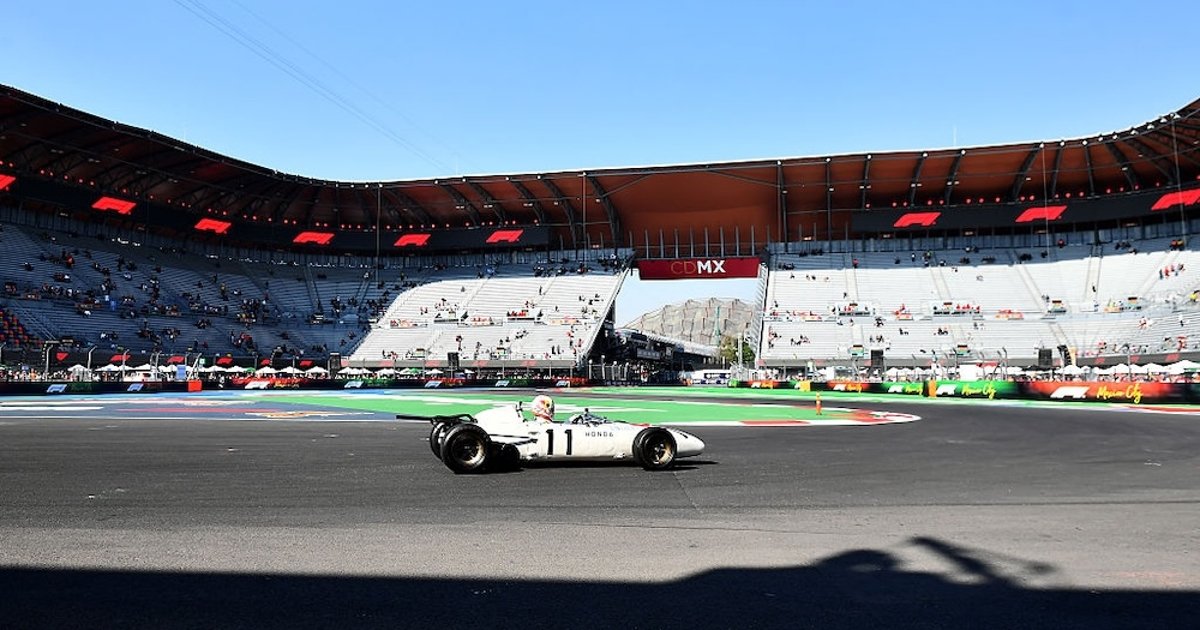
The very first thing you discover is how fairly it’s, however the very first thing you actually discover is the noise.
It’s Sunday morning at Autodromo Hermanos Rodriguez. In a number of hours, Lando Norris will dominate the Mexican Grand Prix to develop into the primary driver within the historical past of F1’s hybrid period to engineer a change within the championship lead inside the last 5 races.
Sixty years in the past to the weekend, Richie Ginther placed on a masterclass of his personal on the similar venue to steer the 1965 Mexican Grand Prix from begin to end. It was the primary F1 win in Honda’s then-short historical past. And now, sitting in its particular pit field simply in entrance of Yuki Tsunoda’s storage, is the automobile Ginther did it in: the Honda RA272, wanting diminutive in comparison with the RB21 up on its stands just some ft behind it.
Even by the requirements of its time it’s not a very complicated-looking automobile from the surface, and the minimalist vibe is accentuated by its cool Japanese flag-inspired livery, which renders it nearly completely white apart from a big pink circle throughout the nostril.
In a couple of minutes, Tsunoda will squirm into the tiny cockpit and drive the RA272 out onto the observe in commemoration of an enormous milestone in Honda’s motorsport historical past, and which means it’s time to fireplace the factor up. A crew of devoted mechanics, decked out in period-style gear, take away the engine cowl to disclose one of many automobile’s trademark quirks: in an period the place V8s have been thought of the norm (though Ferrari did generally race a flat-12, together with at Mexico ’65), Honda opted for a transversely-mounted 1.5-liter V12; a configuration that Honda’s engineers hoped would ship extra peak energy because of its smaller shifting elements and better rotational speeds. They have been confirmed proper: Honda’s V12 was the high-water mark of F1’s 1.5- liter period.
The mechanics poke round for a number of moments, and all of the sudden pitlane is stuffed by with a sequence of loud metallic rattles because the engine – designated the RA272E – clears its throat earlier than constructing right into a distorted bugle blast. Just a few mechanics from the Ferrari storage subsequent door stroll over with their telephones out to document some video. F1 automobiles are exponentially extra subtle these days, however some issues transcend expertise.
The engine cowl goes again on, Tsunoda’s in place, the engine provides a few barks as he feathers the throttle after which the RA272 is on its means down pitlane, following its personal wheel tracks from six a long time earlier.
The 1965 Mexican Grand Prix was an odd race. It was the final of the season, and the final for the 1.5-liter engine components forward of a transfer to three-liter laws for 1966. The automobiles on the grid can be out of date as quickly as they crossed the end line, and with the world championship having already been settled in Jim Clark’s favor two races earlier at Monza (regardless of Clark dropping out with a gas pump downside), one modern report from the day advised that not all groups arrived in Mexico with their eye totally on the ball.
Honda, although, got here loaded for bear. Ginther and compatriot Ronnie Bucknam ran further observe periods from 6am to 9am for 3 days earlier than the primary official observe session, because the Honda crew – making its first go to to a observe 7,000 ft above sea stage – tried to wrap their heads round gas mixtures, in addition to tame some points with their injection programs.
As soon as ‘correct’ working started, the RA272s have been quick, with each drivers lapping within the 1m57s-1m58s vary – lap document territory on the time. At one level the drivers swapped automobiles, and each improved their instances within the different automobile! For the remainder of the sphere, the expertise of being dusted down the lengthy predominant straight was a harbinger of what was to return.
The next day was hotter however the Honda’s tempo remained robust – each drivers once more going faster after a automobile swap – and as soon as qualifying was performed, Ginther discovered himself third with a 1m56.48s that left him 0.31s off Clark’s pole time, and simply 0.07s adrift of Dan Gurney’s Brabham. Bucknum began 10th.
Clark and Gurney’s clear view of the observe didn’t even final till the primary nook. Ginther swept by each of them initially to assert a lead that he retained till the checker, though not with out a scare. A charging Gurney steadily slashed what had been a 7s lead at half-distance all the way down to lower than 4s, forcing Ginther to show up the wick in response. The pair reset the lap document a number of instances earlier than Gurney lastly claimed it at 1m55.84s. However that was a comfort prize: Ginther crossed the end line 2.89s away from his rival, whereas third-placed Mike Spence was nearly a minute additional down the highway in his Lotus.
After the race, Honda crew supervisor Yoshio Nakamura despatched the message ‘Veni, vidi, vici’ to HQ in Tokyo, whereas the New York Occasions – beneath the prosaic headline ‘Ginther aids Honda; Mexico Metropolis victory traced to tuning’ – famous that the motive force as soon as described as “a cheerful little man with an excellent future within the enterprise of vehicle racing” was now “a cheerful little man with a superb opportunity of turning into a world champion.”
Ginther celebrates after dominating the 1965 Mexican GP. It was the primary GP win for himself, Honda and Goodyear – however in Ginther’s case, it could show to be his just one. Getty Pictures
The Occasions’ pioneering motorsport author Frank M. Blunk was incorrect on the final level – Ginther’s first win additionally proved to be his final, though Honda – and Goodyear, which had concurrently put its first W on the board in grand prix racing – had way more success ready on the horizon. The little white automobile with the loud scream by no means raced once more, however for its creators on the opposite facet of the world, it powered numerous goals over the a long time to return.
“When Honda was a small firm – a really small firm! – the founder Soichiro Honda thought that with a view to have a presence, we would have liked to compete within the high class races,” mentioned Honda CEO Toshihiro Mibe, who was in Mexico for the 60th anniversary final weekend.
For Honda, which started as a bike producer, that meant dipping its toes into motorsport by way of the famed Isle of Man TT races, debuting in 1959 with its RC142 bike and successful the Producers’ Crew Award. It gained the race two years later with Mike Hailwood.
Having established his identify on two wheels, Soichiro Honda’s subsequent goal was to do the identical on 4. In 1962, he determined to enter Formulation 1 – a daring alternative for a producer that hadn’t even launched a highway automobile but. (That got here in 1963).
“All people was shocked by that,” mentioned Mibe. “The employees within the firm have been shocked. After which one 12 months after [Honda’s debut in Germany in 1964], we obtained our first win right here in Mexico.
“Now in 2026, we are going to take part once more as a works crew. [But] we are going to change groups – we could have a inexperienced automobile.” (Ed: Honda presently companions with Crimson Bull, however would be the works provider to Aston Martin subsequent 12 months).
The phrase “once more” is doing a little low-key heavy lifting in Mibe’s quote. Like most producers, Honda’s manufacturing facility participation in F1 has been cyclical – its final full works program ran from 2015, when it was initially aligned with McLaren, earlier than switching to Crimson Bull – to 2021.
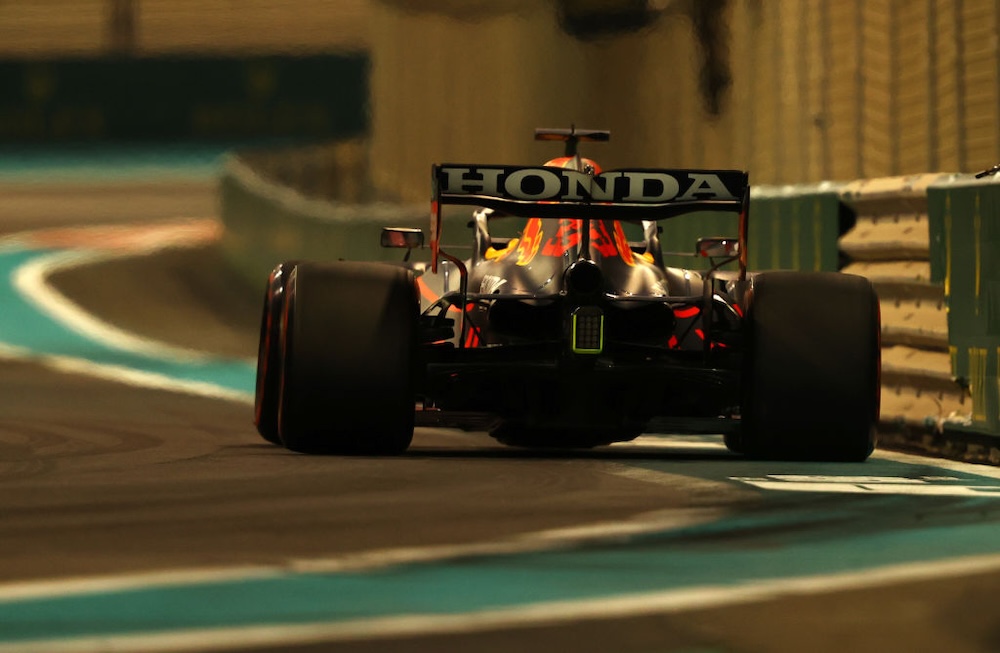
Honda’s final full manufacturing facility F1 program led to 2021 (above), though it has continued to associate with Crimson Bull on its powertrains within the years since. Subsequent 12 months, it returns as works entry with Aston Martin. Bryn Lennon/Getty Pictures
Its return comes at a time when world scale motorsport packages are way more sophisticated to justify than in years previous. Soichiro Honda was in a position to green-light Honda’s first F1 program on the straightforward foundation that he wished to. These days, producers must weigh up apparent components like value towards broader company priorities (Honda’s final exit from F1 was pushed by a need to deal with zero-emission tech comparable to electrification and hydrogen), in addition to world issues like politics and the surroundings.
So whereas racing is in Honda’s DNA, really going out and doing it has develop into an train in balancing the corporate’s heritage and ethos towards the realities of performing within the broader pursuits of a multinational company.
“Subsequent 12 months, we’re calling our ‘fifth technology’ (in racing),” mentioned Mibe. “We’ve been collaborating, quitting, collaborating once more subsequent 12 months… Every technology, the CEOs have mentioned that racing prices some huge cash, so generally we’ve give up to focus on our enterprise.
“However all workers at Honda are conscious that we’ve got this (racing) DNA. That’s why we determined for this fifth technology to as soon as once more take part in F1. We would like this technology to be steady. So for that motive HRC (Honda Racing Company) is working independently to deal with stabilization, and Mr. Watanabe (Ed: Koji Watanabe, HRC president) is placing numerous effort into realizing that.”
“The aim,” added Watanabe with a smile, “is to not create six generations.”
Reaching that aim will come down largely to managing prices. HRC is actively creating its efficiency elements division, however it should take greater than that to cowl the huge expense required to be aggressive in F1.
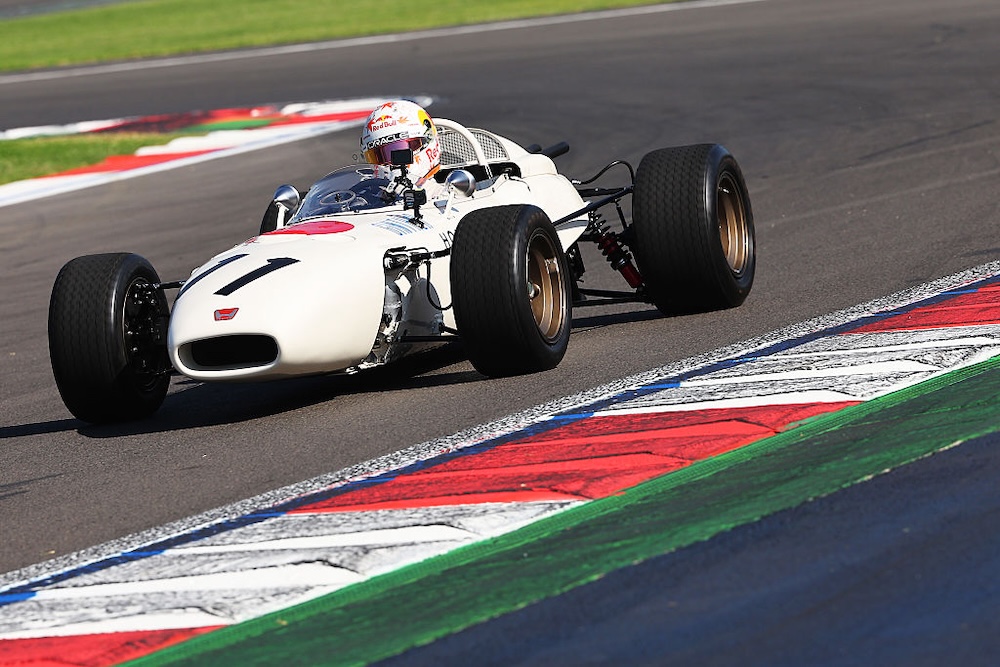
The 1965 Mexican GP-winning Honda RA272 was visitor of honor finally weekend’s Mexican GP, the positioning of its historic triumph 60 years earlier. Colin McMaster/Getty Pictures
“F1 is the costliest racing on this planet,” mentioned Mibe. “However we’re in discussions in regards to the laws to manage the sum of money we’re utilizing. F1 is high-technology so we can’t scale back so much, as a result of we additionally must hold creating new expertise. So we must discover a stability. Assembly the fee cap is tough, so we have to handle our sources to care for that and hold our competitiveness, and I feel that would be the new problem for us.”
On paper, Honda’s fifth technology seems to have all of the substances to be an thrilling one. In preparation for a reset in F1’s technical laws, Aston Martin made a headline-grabbing transfer to signal Adrian Newey, who has led the event of the 2026 automobile. His arrival was the sharp tip of a much more wide-ranging improve of the crew’s design and engineering muscle over the previous 12-18 months.
Then there’s Aston Martin’s recently-opened 400,000 sq. foot AMF1 Crew Expertise Campus, a three-building facility at Silverstone that homes the entire crew’s design, engineering and manufacturing sources, together with a brand new wind tunnel.
All that’s earlier than you think about Honda itself, and the firepower that has already delivered 89 victories, 223 podiums, six Drivers’ championships and 6 Constructors’ titles as an engine producer. (Plus one other three GP wins as a full entrant, with John Surtees following up Ginther’s early success with victory at Monza in 1967 within the Eric Broadley-designed ‘Hondola’ RA300, and Jenson Button giving the RA106 its day within the solar nearly 4 a long time later on the 2006 Hungarian GP).
How a lot all that on-paper potential interprets to the observe is a query that may begin to be answered at Albert Park subsequent March, when a narrative that started with an upstart producer from Asia, a Hollywood-born “glad little man” recognized for his check and improvement prowess, and a cute automobile with an equally cute however evolutionary engine prepares to walk into its subsequent chapter as Aston Martin Aramco Honda. RA272 delivered on Soichiro Honda’s dream, however there are heaps extra for the corporate he constructed to go and chase.
