


This week, I learn a narrative that mentioned how the state of Ohio had given money by way of a tax credit score program to a number of Cincinnati tasks, one in every of which was for a brand new metropolis conference middle. Nonetheless, the state denied FC Cincinnati a request for $26.4 million {dollars} to “bolster its…mixed-use entertainment district”. I perceive being offended on the rejection. Who wouldn’t need further cash from the town or state? However after I noticed FC Cincinnati’s response to this, I used to be a bit stunned:
The membership’s chief improvement officer Chad Munitz expressed his disappointment in a press release to The Enquirer: “Our venture adjoining to TQL Stadium within the West Finish is the definition of a transformational mixed-use improvement venture and with out these tax credit, we should revisit the venture’s timing and funding technique.” — Cincinnati.com, 01/29/24
So, is FC Cincinnati saying that they received’t transfer ahead with out this extra cash? As a result of we by no means heard FC Cincinnati say something about this additional taxpayer money being necessary when the stadium contract was negotiated. In 2017, the crew’s Principal proprietor, Carl Lindner III, talked about to the Cincinnati Enquirer that they have been “looking to develop an appropriate public-private partnership that’s possible without new taxes or increases on our people”. On the time of those feedback, 2017, Cincinnati’s metropolis leaders have been making an attempt to determine easy methods to get out of a $32 million budget deficit. I will even simply ignore the truth that in 2018, the mayor increased property taxes due to a major variety of tasks that wanted work, consists of stadium-related gadgets.
“The return on the funding is worthy of a partnership…A 3rd celebration, a public authority, can personal the stadium. The county doesn’t should personal the stadium. Taxpayers don’t should be liable for price overruns. Taxpayers don’t should be liable for bells-and-whistle upgrades, and taxpayers don’t should be on the hook if a…public funding supply underperforms” — FC Cincinnati President and Normal Supervisor Jeff Berding, Cincinnati.com, 10/27/17

This is similar crew who initially claimed {that a} new stadium by itself could be an “economic driver” to the encompassing space? Higher but, constructing a brand new stadium was “guaranteed to bring dividends” to the world.
When FC Cincinnati launched plans for a possible mixed-use improvement, they informed metropolis leaders that the “developments would be handled by outside investors”. Exterior of that, it’s tough to seek out any instance of the crew discussing funds for this mixed-use improvement. I proceed to seek out article after article of the crew speaking about how this mixed-use improvement will likely be full with a “hotel, apartments, office space, retail, restaurants, music/entertainment venues and a plaza”. However the part of who pays for what will need to have been torn out.
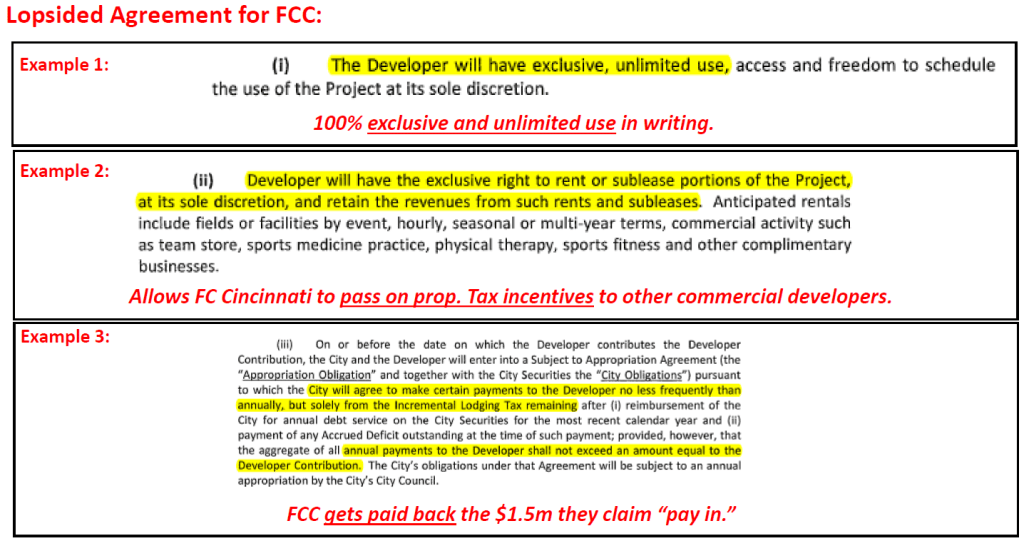
Let’s concentrate on what we do know, then. We all know that FC Cincinnati has plans for an leisure district, a 150-room resort tower, 450+ flats, 85,000 sq. toes of economic and retail area and as much as 600 parking areas. Final yr, FC Cincinnati requested the town to make main adjustments to the stadium settlement. The crew wished further land to be deemed as “planned development” and for the boundary of the event to be elevated additional north. FC Cincinnati additionally requested the town to promote and vacate a lot of properties across the stadium. As soon as all of those adjustments have been made, FC Cincinnati wouldn’t solely “remain in control of the entire development site” but additionally deliberate to “acquire privately held parcels within the planned development zone”.
