

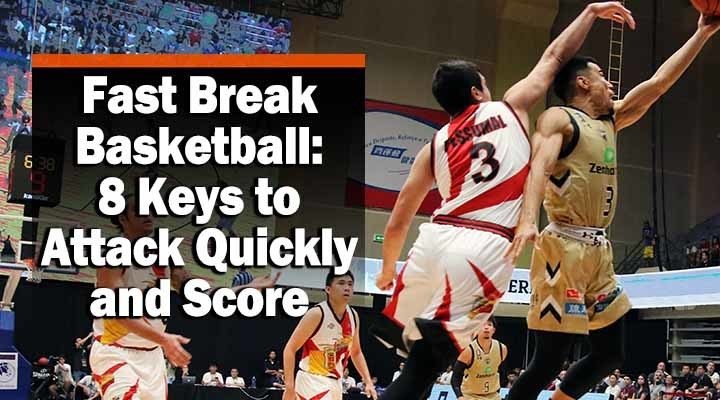

A quick break is when a crew pushes the ball up the courtroom instantly after gaining possession, seeking to rating earlier than the protection can get organized.
It is the best option to create high-percentage pictures in basketball.
And whereas each crew runs the occasional quick break, the groups who decide to it (and observe it every day) flip it into a real aggressive benefit.
What Is a Quick Break in Basketball?
A quick break is an offensive technique the place a crew strikes the ball up the courtroom as rapidly as potential after a steal, blocked shot, defensive rebound, or made basket.
The aim is straightforward:
Assault earlier than the protection will get set, making a numbers benefit (2-on-1, 3-on-2) or an uncontested layup.
You may additionally hear the quick break known as “transition offense” as a result of it occurs whereas each groups are transitioning – one from protection to offense, the opposite from offense to protection.
This is why it really works so properly:
Following a steal or a rebound, the brand new offense can assault instantly, whereas the brand new protection wants a second or two to seek out their matchups and get organized.
Which means the offense begins almost each possession with a small head begin.
It is a lot simpler to take care of a bonus than it’s to create one towards a set protection… which is precisely why the perfect offensive groups SPRINT the ground on each change of possession.

How a Quick Break Works (The 4 Phases)
Each quick break follows the identical 4 phases:
1. The Cease – The break begins with the protection. Your crew beneficial properties possession by way of a steal, a blocked shot, a defensive rebound, or by inbounding rapidly after an opponent’s made basket. Reside-ball turnovers create the perfect quick break alternatives as a result of the protection is dealing with the fallacious method.
2. The Outlet Cross – The rebounder instantly passes to a teammate (normally a guard) close to the sideline or pushes the ball themselves. The longer the outlet cross, the nearer it will get you to the basket. Consider Nikola Jokić, Wes Unseld, or Kevin Love grabbing a rebound and firing it the size of the ground in a split-second for an uncontested layup.
3. Filling the Lanes – Gamers dash the ground in unfold lanes — wings run broad to the sidelines, the ball handler assaults the center, and a rim-runner sprints straight to the entrance of the ring. Broad spacing stretches the retreating protection and opens up driving and passing lanes.
4. The End – The offense converts earlier than assist arrives: a layup, a dunk, or an open leap shot. The layup is at all times the primary choice. And each quick break ought to have a trailer sprinting behind the play, as a result of missed quick break layups are probably the most frequent (and most fixable) wasted possessions in basketball.
Why Run a Quick Break?
There are 5 massive the explanation why I like to recommend quick break basketball to nearly each crew:
1. Straightforward Scoring Alternatives – Scoring towards a set half-court protection is tough at each stage. Quick breaks generate layups and open pictures earlier than the protection is organized. Nice groups anticipate to attain a excessive proportion of their factors in transition.
2. You Will Have Poor Capturing Nights – Quick break layups are one option to win on the nights when your leap pictures aren’t falling… and each crew has these nights. In case your offense depends on taking pictures a excessive proportion each sport, you are going to be disenchanted typically.
3. Transition Protection is HARD – Watch any youth or highschool sport and you may see gamers caught in “no man’s land” after a shot goes up — not crashing the boards, not sprinting again. Groups who stroll the ball up the courtroom by no means exploit this weak spot.
4. It Wears the Opposition Down – Enjoying quick by no means offers the protection an opportunity to catch their breath. Groups who aren’t used to the tempo will make increasingly more errors as the sport goes on. It additionally creates extra possessions, which implies extra taking part in time on your bench and extra improvement on your full roster.
5. It Beats Zones and Presses – The very best offense towards a zone protection is to attain earlier than the zone is ready. The identical goes for beating strain — when you break the press, assault instantly as a substitute of letting the protection recuperate.
Sorts of Quick Breaks
Coaches typically run considered one of two quick break techniques:
1. The Numbered Break – Each participant is assigned a selected lane or position they have to fill on each possession. For instance, the two at all times runs the best wing, the three at all times runs the left wing, the 5 at all times rim-runs. Well-known examples embrace Dean Smith’s “Carolina Break” and Paul Westhead’s Loyola Marymount system.
2. The Free-Movement Break – No assigned lanes. Gamers dash the ground and fill no matter lane is sensible from wherever they’re on the courtroom. The overall rule: if you happen to’re forward of the ball, run broad; if you happen to’re behind the ball, fill the center.
Which one do you have to use?
Loads of nice packages have run numbered breaks… however I do not advocate them, particularly for youth and highschool groups.
Three the explanation why:
a. You by no means know the place gamers will find yourself – In case your taking pictures guard simply contested a shot on the left wing, do you really need them sprinting sideways throughout the courtroom to fill their assigned proper lane? I would somewhat they take off and get the layup.
b. Gamers will get their roles combined up – The numbered break requires flawless communication as gamers substitute out and in. That will not occur. You may find yourself with two gamers sprinting the identical wing arguing about whose lane it’s.
c. Gamers cease studying the ground – Like set performs, assigned lanes take away the decision-making from the sport. Gamers find yourself working their routes with out pondering as a substitute of studying to learn the protection and assault the open area.
8 Keys to Quick Break Success
1. Develop a Powerful Protection First – The very best quick breaking groups are constructed on protection. I like to recommend man-to-man or the pack line defense. It is potential to run off made baskets, however it’s MUCH simpler to run off stops… and better of all off live-ball turnovers. Present your gamers the correlation between defensive stops and simple transition factors.
2. Let Anybody Push the Ball – Do not drive your rebounders to pause and hunt for the purpose guard. Empower each participant to seize a rebound and go. That pause of a second or two is precisely the benefit the quick break is constructed on – even NBA groups now practice their bigs to “catch and go” for that reason. For youth coaches, this doubles as improvement: turnovers could enhance short-term, however your complete roster learns to deal with the ball.
3. Instill a Quick Break Mindset – I like to recommend the time period “RACE.” We need to race down the ground each possession to discover a possible benefit. An idea I picked up from a Ultimate 4 coaches’ clinic makes this concrete: after each change of possession, every participant’s first three steps have to be faster than their opponent’s first three steps. Win the primary three steps constantly and you may choose up 2-3 further transition scores a sport.
4. Cross Forward As a substitute of Dribbling – The ball strikes sooner by way of the air than it does on the bounce. Construct the behavior of passing up the sideline to realize separation from the protection. If the ball-side wing is not open, the ball handler can “slice” by way of the center and look to the other wing – defenses load to the ball facet, which leaves the weak facet open.
5. Assault Benefit Conditions Aggressively – In an ideal world, each break ends in a 1-on-0 layup. Extra real looking are the 2-on-1 and 3-on-2. In a 2-on-1, we at all times desire a layup. In a 3-on-2, we would like a layup or a wide-open leap shot. Many gamers are indecisive in these moments, so drill them consistently till attacking turns into computerized.
6. Use Breakout Dribbles – When a participant catches in area with no teammate forward, they need to advance the ball with massive, aggressive dribbles. Train “chest to the ground” in a sprinter’s stance with lengthy crossover dribbles. This covers most distance and protects the ball from trailing defenders.
7. Hunt the Paint – Assist your gamers perceive WHY you are taking part in quick: to get the ball into the paint earlier than assist arrives. If the rim-runner has two ft within the paint, your perimeter gamers MUST look to cross it to them (if bigs aren’t rewarded for sprinting the ground, they will cease sprinting). And when a defender offers an extended closeout to a wing in transition, that is an invite to shot faux and assault.
8. End Below Management – Sprinting at full pace is just half the ability… ending is the opposite half. Train gamers to lift their eyes early, get on stability, and both end the layup or leap cease and pivot to discover a teammate. A head-down, out-of-control dash to the rim normally ends in a wild miss, regardless of how open the ground was.

Flowing Into Your Half-Court docket Offense
The very best transition groups by no means come to a full cease.
Consider your offense as protecting three conditions:
State of affairs 1: Reside-ball change of possession – Run the quick break instantly. Cross forward and search for the short rating.
State of affairs 2: Protection is again, however not organized – That is the secondary break window. Defenders are scrambling, matchups aren’t sorted, and assist is not in place. Movement into one or two easy actions to assault earlier than they settle.
State of affairs 3: Protection is again and arranged – Run your half-court offense or a set play from a impartial begin.
Most groups are respectable at conditions 1 and three.
It is the center window – these few seconds between “no layup” and “protection absolutely set” – the place video games are gained. Should you can maintain strain on with good actions and good spacing, you will create high quality pictures earlier than the protection can react.
Listed below are two actions we use in that window:
1. Pistols
A standard NBA motion triggered by a wing entry, both off the cross or a dribble handoff. It creates an instantaneous two-player sport on the wing whereas the protection remains to be recovering.

2. Klay
Run when the ball is within the slot. A “Klay Lower” is our time period for what some coaches name a “ghost display screen” or a “working slip.” The 4 sprints on the ball handler, fakes a ball display screen, and slips into open area. The protection has to guess, and both the ball handler will get a free driving lane or the 4 pops open for a shot.

Each actions stream straight into the 4-out motion offense. Achieve a bonus with the break, keep it by way of Pistols or Klay, and proceed into your motion offense with out ever letting the protection get set.
Quick Break Drills
There aren’t any magic drills that immediately flip a crew into an elite transition squad.
The true secret is emphasizing transition in all the things you do. Basketball is a sport of fixed transition, and the best method to enhance transition play is to transition so much in observe. Full-court, aggressive small-sided video games are the perfect device for the job.
That stated, listed here are two drills we have discovered particularly useful:
a. 3-Minute Video games
This can be a quite simple idea, however it’s nice for serving to your gamers develop a quick break mindset.
And even if you happen to aren’t an enormous transition crew, it is a wonderful conditioner early within the season.
Merely full courtroom scrimmage for 3 minutes.
Rating the sport as you usually would with one exception:
Award some extent each time the offensive crew will get the ball beneath the foul line in 5 seconds or much less.
If potential, assign an assistant coach or father or mother the duty of counting down from 5 on each change of possession.
This rule encourages the offense to SPRINT and look to cross forward if they need the potential further level.
Award this level no matter if the offensive crew scores on that possession.
For instance…
If the offense will get the ball beneath the foul line in 5 seconds and passes to the rim-runner for a layup, that might be a 3-point possession.
b. 5-on-5-on-5
This sport might be performed 3-on-3 or 4-on-4, however 5-on-5 means that you can work on the Pistols and Klay choices when your crew does not rating in major transition.
This is the way it works:
Two groups play 5-on-5, with a 3rd crew standing on the sideline.
(you probably have 20 or extra gamers, 4 or extra groups can play)
Play till somebody scores.
If Staff 1 scores, Staff 2 is out.
Staff 1 then pushes the ball the opposite route as Staff 3 sprints on.
The crew getting into should contact half courtroom and talk their matchups as they rapidly get into their defensive positions.
This can be a enjoyable sport that develops offensive and defensive transition, whereas additionally serving as an excellent conditioner.
Should you want to extend particular person accountability, you possibly can play with fewer gamers. For instance, 3 on 3 on 3 makes it much more apparent who will not be executing in offensive and defensive transition.
Who Invented the Quick Break?
Frank Keaney is most frequently credited with originating the quick break on the College of Rhode Island within the Twenties and 30s, the place his groups averaged almost 80 factors a sport in an period when most groups barely scored 50.
Cam Henderson of Marshall College can also be acknowledged as one of many early innovators of the break.
And John McLendon, who studied beneath basketball’s inventor James Naismith at Kansas, pioneered the quick break model at traditionally Black faculties within the Nineteen Forties and 50s, pairing it with full-court strain and actually writing the e book on it (Quick Break Basketball, 1965). A lot of the trendy up-tempo sport traces again to McLendon.
Quick Break FAQ
What’s a quick break in basketball?
A quick break is when a crew pushes the ball up the courtroom instantly after gaining possession – off a steal, block, rebound, or made basket – seeking to rating earlier than the protection can get set. It normally produces a layup or an open shot from a numbers benefit like a 2-on-1 or 3-on-2.
What is the distinction between a quick break and transition offense?
The phrases are sometimes used interchangeably. When coaches do separate them, the quick break refers back to the rapid dash for a layup or numbers benefit, whereas transition offense covers all the things from the change of possession till the half-court offense begins – together with the secondary break.
What’s a secondary break?
The secondary break is what a crew flows into when the first break does not produce a shot. As a substitute of pulling the ball out and resetting, the offense runs fast early-offense actions (like Pistols or a ghost display screen) whereas the protection is again however not but organized.
Who leads the NBA in quick break factors?
Within the 2025-26 season, LeBron James led the NBA in quick break factors per sport, with Tyrese Maxey and Kawhi Leonard shut behind. The Toronto Raptors led all groups at almost 19 quick break factors per sport.
What are the perfect quick break drills?
The very best quick break drills are full-court and aggressive – 3-Minute Video games, 5-on-5-on-5, and the 30-Second Cycle are three we advocate. Small-sided video games (3-on-3 and 4-on-4 full courtroom) are particularly efficient as a result of each participant will get extra selections and extra sprints per possession.
Conclusion
Committing to quick break basketball can profit nearly any crew.
Dash the ground on each change of possession, cross forward, hunt the paint, and stream into your offense with out stopping.
Even when your crew isn’t the quickest in your schedule, the behavior of advancing the ball rapidly to discover scoring alternatives will maintain fixed strain on the protection – and win you simple factors that strolling the ball up the courtroom leaves behind.
